| |
Air-gap: An air-gap capacitor has a low dielectric loss. Large-valued,
tunable capacitors that can be used for resonating HF antennas can be made this
way.
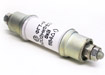
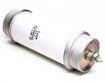
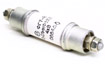
Ceramic: The main differences between ceramic dielectric types are the
temperature coefficient of capacitance, and the dielectric loss. C0G and NP0
(negative-positive-zero, i.e. ±0) dielectrics have the lowest losses, and are
used in filters, as timing elements, and for balancing crystal oscillators.
Ceramic capacitors tend to have low inductance because of their small size.
NP0 refers to the shape of the capacitor's temperature coefficient graph (how
much the capacitance changes with temperature). NP0 means that the graph is
flat and the device is not affected by temperature changes.
Glass: Used to form extremely stable, reliable capacitors.
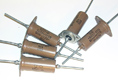
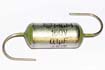
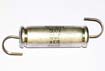
Paper: Common in antique radio equipment, paper dielectric and aluminum
foil layers rolled into a cylinder and sealed with wax. Low values up to a few
uF, working voltage up to several hundred volts, oil-impregnated bathtub types
to 5,000 V used for motor starting and high-voltage power supplies, and up to
25,000 V for large oil-impregnated energy discharge types.
Polycarbonate good for filters, low tempco, good aging, expensive
Polyester, (PET film): (from about 1 nF to 1 uF) signal capacitors, integrators.
Polystyrene: (usually in the picofarad range) stable signal capacitors.
Polypropylene: low-loss, high voltage, resistant to breakdown, signal
capacitors.
PTFE or Teflon ™: higher performing and more expensive than other plastic
dielectrics.
Silver mica: These are fast and stable for HF and low VHF RF circuits,
but expensive.
Vacuum: Expensive, housed in glass or ceramic body, typically rated for
5kV - 30kV. Typically used in high power RF transmitters because the dielectric
has virtually no loss and is self-healing. May be fixed or adjustable.
|